While I keep up with most technology, if only a step behind sometimes, I don't turn my back on older technology. Some say that print is dying these days and they might be correct, but books will always be around if not in a different form. Some say that you can find anything on the internet and while there is a lot of information on the web that can help you improve you artwork it won't always have all the answers. So it is always good to keep a good library of helpful books about technique and subject matter for you to refer to. With that in mind, here are some of my suggested readings and why to get them.
Framed Ink
Framed Ink is one of my go to books to understanding the tips and a tricks of creating a good composition and visual storytelling. The book is fully illustrated with good compositions which are then broken down into easy to understand visual shapes of those compositions. This is a must have book if you want to start learning to master composition.
A Glossary of Construction, Decoration & Use of Arms & Armor
It is always good to keep good reference material around and as an illustrator I need to be able to cover a lot of subjects. This book by George Cameron Stone is a great book for seeing a large variety of different weapons from throughout history and around the world. It has a ton of photo references from you to draw upon and it is an interesting read. If you do a lot of fantasy work then this is a great addition to your library.
Animal Anatomy for Artist: the Elements of Form
One of the hardest things an artist can master is to correctly draw the human form, but that is only because as humans we will pick at it more. Drawing the anatomy of animals is just as challenging. The book is fully illustrated with a wide variety of different animals, the structure of the bones, their muscle structure and different views to help an artist draw animals more realistically. The only draw back is that it doesn't cover reptile muscle structure, but it does cover birds and a wide variety of mammals. This is a must have and is well worth the cost.
So what is in your library? If anyone knows a good anatomy book that covers reptiles and shows their muscle structure I would love to know about it.
News and updates about my artwork, tutorials, thoughts and other cool stuff.
Showing posts with label Tobias White. Show all posts
Tuesday, May 14, 2013
Friday, March 22, 2013
Arkham: A nice place to Visit: My process
Ever since Mike Davis was kind enough to show my War of the Worlds Vs Cthulhu composition on his website Lovecraft Ezine and on his corresponding Facebook Page it has been getting more coverage than I have ever had before. So I thought it would be a good idea to share a little bit about the process I took in creating it as well as my other art.
However, before I get to my process I will share a detail that doesn't show up well on the versions that I have up on the internet for viewing. First there is a lot more detail to Cthulhu and second is the billboard advertisement for the fictional Arkham City. While this doesn't show up in most of the web versions, it does show up well on a full size print which can be bought through Zazzle or Deviant Art which you can get to via the page tabs above.
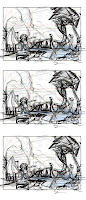
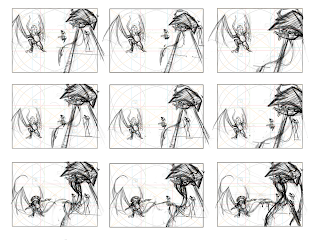
The first step I took when planning this composition is working up some quick thumbnail sketches in Photoshop. The ratio size of these thumbnail sketches are in direct proportion to the size of the canvas that I desired for the final piece. I already had a good idea of what I wanted, because I had visualized it in a dream, so the changes are minor in the variations for these thumbs, but often this process is a brain storming session, because while at times I might have started off with a small seed of an idea, thumbing may allow it to grow into anything. Mostly what I was looking for was positioning and poses for the primary and secondary foci of this composition. To help me with placement I used my golden ratio overlay tools. You can find out more about that on my Golden-Compositions post. After finding the general positioning and poses that I like, I then add in more content with a few more thumbnails for a more complete composition.
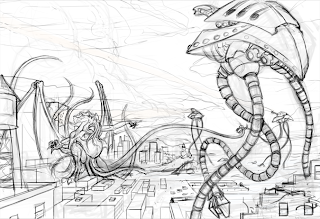
After I choose the final thumbnail sketch I scale this rough sketch up to a large size canvas and refine the sketch more. During this sketch I am looking for a tighter drawing so my concerns are about proper perspective and form since I don't have to worry about the compositional placement anymore. I also add in more details, but I keep these details loose because I don't want to obsess about it; this is a easy trap to fall into and I try to avoid it at all costs. I sketch right into Photoshop via my Wacom tablet and I do so on a transparent layer because this allows me to paint underneath my sketch so that I can keep my drawing separate from my painting, because the last thing you want to do is be destructive to the work you have already done.
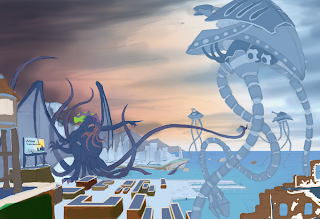
Painting now begins and I start off lowering the opacity of my sketch to around 30% and then lock the layer. I then create a new layer under this and begin painting the local colors I want for all my objects. Sometimes, I will go back and change this as needed. Your local colors are the true color of your objects but they will be effected by the temperature of light and shadow later and so will look very different later on. The only exception I made here was the sky. When I paint skies I just let my intuition take over and taking logic out of the process because doing skies I find to be an abstract experience.
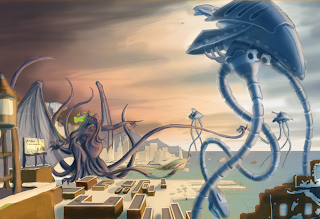
When finished with that I lock my local color layer and then create two new layers over this to start working in light and shadow. One layer is set to multiply at a lower opacity and soft light on the other. To know more about this process you can check out this other article I wrote called color-blending-fx-brushing-and-photos which not only explains the process but also includes video tutorials I have created.
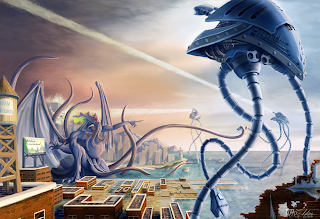
Now that I have color and value down close to what I want, I create merged copy layer of what I have created so far and paint directly on that; this way my canvas becomes my pallet and I don't have to worry about using color swatches. I then clean up and make alteration to color as I think it needs it. I also starting laying in some base texture as a starting point for texture and details. I use these textures merely as a starting point and guide and I paint over this to fit the painting. If you would like to know more about textures then you might check out my texture-hunter part 1.
My last step is to bring the painting home, which generally means that I continue painting in refinements, textures and details. The very last effort I made on this painting was to make one more merged copy of the work I had so far and rotated the image a few degrees for a dutch angle to create some mood but the reason I only did this a little bit because I didn't want to throw my compositional placement off. If I find that I cannot figure out what more to do or if I am getting fussy over the painting I walk away from the painting for several hours and then come back to it with fresh eyes.
So I hope you found this interesting and helpful and would be glad to answer any questions so feel free to ask them in the comment box.
Friday, January 25, 2013
Leaps, bounds and Muscle Memory
For all the artists out there, frustrated that perhaps their skills are not growing fast enough, I give the advice of patience and diligence. While this advice might seem pat, I can assure you that this advice is sound for it is backed up from my talks with other artists about our shared personal experiences. The skills of some artist’s you see, grow at a slow and steady pace as they garner their art education and this is reflected in their work which slowly plateaus, but other people on the other hand learn by what I call “Leaps and Bounds” from which seemingly, from time to time, to spontaneously increase in skill.
“Leaps and Bounds” in this case is a misnomer, it only appears to others, and sometimes even to yourself, that your skills periodically and spontaneously increase in level, which is then followed by a plateau time period before the next jump. What is really happening is that the education learned from teachers, peers and self-education has only laid dormant, then to surface when the artist is ready. The “ready” moment, varies from artist to artist and often won’t show for months or even years, so these artists need to learn a lot of patience. However, this plateau period of little or no growth is just an incubation period for the conscious and subconscious is assimilating the information, assembling its self like a jigsaw puzzle, then when the artist is ready to leave their comfort zone, those skills come forth in a epiphanic bloom.
The “Leaps and Bounds” artist have the advantage of continued and ever climbing growth, but this is a double edge sword, for if the artist stops painting or drawing they start to go down hill and must re-learn everything once again. So, it is vital that artists who learn this way to maintain their skills and keep up the effort to always learn more about their craft. The diligent artist, no matter how they learn, gain a secondary skill which is called muscle memory, yet another misnomer. Actually, muscle memory crosses over into any skill and it is gain merely from everyday practice. You know when a skill has become muscle memory when you switch from thinking about what you are doing and not how you are doing it. For artists, muscle memory takes many years to totally sink in, but when it does, the artist’s art is like a bird released from a cage.
So to all those frustrated artists out there who think their skills are not improving, hang in there, don’t give up and keep up the diligence, for you will never know when you will have a “Leaps and Bound”.
“Leaps and Bounds” in this case is a misnomer, it only appears to others, and sometimes even to yourself, that your skills periodically and spontaneously increase in level, which is then followed by a plateau time period before the next jump. What is really happening is that the education learned from teachers, peers and self-education has only laid dormant, then to surface when the artist is ready. The “ready” moment, varies from artist to artist and often won’t show for months or even years, so these artists need to learn a lot of patience. However, this plateau period of little or no growth is just an incubation period for the conscious and subconscious is assimilating the information, assembling its self like a jigsaw puzzle, then when the artist is ready to leave their comfort zone, those skills come forth in a epiphanic bloom.
The “Leaps and Bounds” artist have the advantage of continued and ever climbing growth, but this is a double edge sword, for if the artist stops painting or drawing they start to go down hill and must re-learn everything once again. So, it is vital that artists who learn this way to maintain their skills and keep up the effort to always learn more about their craft. The diligent artist, no matter how they learn, gain a secondary skill which is called muscle memory, yet another misnomer. Actually, muscle memory crosses over into any skill and it is gain merely from everyday practice. You know when a skill has become muscle memory when you switch from thinking about what you are doing and not how you are doing it. For artists, muscle memory takes many years to totally sink in, but when it does, the artist’s art is like a bird released from a cage.
So to all those frustrated artists out there who think their skills are not improving, hang in there, don’t give up and keep up the diligence, for you will never know when you will have a “Leaps and Bound”.
Sunday, January 20, 2013
Digital Freehand Inking With Adobe Illustrator
Being a good inker is a valuable skill as either a comic book artist, graphic designer or an illustrator. While traditional inking skills with brush and pen makes for a good solid foundation, having digital inking skills in today's day and age is a must. When it comes to digital inking, knowing how to handle the pen tool is a must and it was something I quickly had to learn during my internship at MGA Entertainment, however using the pen tool, while can give you a lot of control, also takes a lot of time and has it's own problems. The ability to ink fast is another skill that is a must in the art world, because let's face it, the faster you can do quality work the more money you can make. So in this video I am showing how to digitally ink using the blob tool which is more intuitive and has a more natural look. In this video I have used a Cthulhu sketch I did for T-shirt flair in my new clothing line I am calling Lovecraftian Flair.
Sunday, January 6, 2013
Talent, Potential and Skill
I want to talk about a little thing people call talent, it doesn’t exist, except in the minds of people who are unable or unwilling to do well in something creative or wonderful. Let me expand on that, from my own experiences and through talking with other creative types about their experiences, I found that when someone says, “This person has talent”, they have the mind set that the person they refer to has some innate ability that allows them to do wonderful and creative things without effort. This is from the truth, because every successful creative person out there had the passion to dedicated themselves to the time and effort it took to get their skill to that level, it isn’t easy.
While I don’t believe in talent, I do believe in potential and aptitude. Every single person has the potential to do wonderful things if they dedicate themselves, but some people have more aptitude than others in achieving wonderful things and that is the only real edge they have. Lets take artists for example, they start off drawing young just like everyone else and for the most part they don’t draw any better than anyone else and the only difference is that they either took more enjoyment from it or took it more seriously. So, as that artist grows up they continue to draw and learn from mistakes. Sometimes, if lucky, the artist grows up in a family that has an artist or two living with them, whom they can learn from. If the passion is particularly strong that artist might ask for art lessons or get books on the subject, but still that is not always enough. If the artist stops their artwork longer than a year they become rusty and have to retrain and this is devastating. The successful artist is the one that seeks help through training but also continues self education and is willing to explore, make mistakes, and discover for greater understanding to create wonderful art. So, the successful creative person often puts years upon years of time, effort, and dedication in order to become good at what they do; sometimes this takes a life time.
Enclosing, always remember that if you want a writer, artist, musician or other creative type to produce something wonderful for you, your business or any other venture, remember we all work for a living.
"If you are good at something never do it for free"— Joker (Heath Ledger)
The following pieces of art are to the best of my knowledge in chronological order to show how long it took me to progress to my current skill level in art.
Around Age 5
Around Age 8-10
Around Age 8-11

Around Mid Teens ( I think I am going to revise this comp it is just to fun to pass up)

Around mid to Late Teens (was modifed in PS 10 years ago can't find original was two separate pieces)
Around mid to late Teens

Early 20s

Early 20s
Mid 20s

Mid to late 20s finally in college studying art
Late 20s still learning to paint digitally
Present day!
Don't forget, you can also purchase many of my works as full sized prints at TBW Designs On Zazzle
While I don’t believe in talent, I do believe in potential and aptitude. Every single person has the potential to do wonderful things if they dedicate themselves, but some people have more aptitude than others in achieving wonderful things and that is the only real edge they have. Lets take artists for example, they start off drawing young just like everyone else and for the most part they don’t draw any better than anyone else and the only difference is that they either took more enjoyment from it or took it more seriously. So, as that artist grows up they continue to draw and learn from mistakes. Sometimes, if lucky, the artist grows up in a family that has an artist or two living with them, whom they can learn from. If the passion is particularly strong that artist might ask for art lessons or get books on the subject, but still that is not always enough. If the artist stops their artwork longer than a year they become rusty and have to retrain and this is devastating. The successful artist is the one that seeks help through training but also continues self education and is willing to explore, make mistakes, and discover for greater understanding to create wonderful art. So, the successful creative person often puts years upon years of time, effort, and dedication in order to become good at what they do; sometimes this takes a life time.
Enclosing, always remember that if you want a writer, artist, musician or other creative type to produce something wonderful for you, your business or any other venture, remember we all work for a living.
"If you are good at something never do it for free"— Joker (Heath Ledger)
The following pieces of art are to the best of my knowledge in chronological order to show how long it took me to progress to my current skill level in art.
Around Age 5
Around Age 8-10
Around Age 8-11
Around Mid Teens ( I think I am going to revise this comp it is just to fun to pass up)
Around mid to Late Teens (was modifed in PS 10 years ago can't find original was two separate pieces)
Around mid to late Teens
Early 20s

Early 20s
Mid 20s

Mid to late 20s finally in college studying art
Late 20s still learning to paint digitally
Present day!
Check out more of my work at Tobias White Illustrations
You should also follow me on Facebook, linkedin, Deviant Art, or catch me at @TobiasWhite1 Don't forget, you can also purchase many of my works as full sized prints at TBW Designs On Zazzle
Monday, December 24, 2012
Visions of Revision
For those that follow my work regularly, they know that my artistic skills have improved over the years. However, when I look back at my past work I still see the potential those composition had. Leonardo da Vinci once said, "Art is never finished, only abandoned" but instead of living with that abandonment I have taken it upon myself to revisit my older works and improve them to make them stronger.
Don't forget, you can also purchase many of my works as full sized prints at TBW Designs On Zazzle
Before and After
Wishful Thinking
Before and After
Grand Priestess of Cthulhu
Before and After
Cthulhu's Rising: Humanity's Defiance
Before and After
Grand Priestess of Cthulhu 2
Of course I started these revisions off with my Lovecraft pieces as that is something I specialize in, but there will be more revisions to come and they will cover a more variety of subject matters. Feel free to ask any questions you may have and also don't forget to visit my new online store in which you can purchase these paintings as full size prints or as other products such as coffee mugs, skate boards and more!
Check out more of my work at Tobias White Illustrations
You should also follow me on Facebook, linkedin, Deviant Art, or catch me at @TobiasWhite1 Don't forget, you can also purchase many of my works as full sized prints at TBW Designs On Zazzle
Wednesday, May 30, 2012
Mundane Wars Project

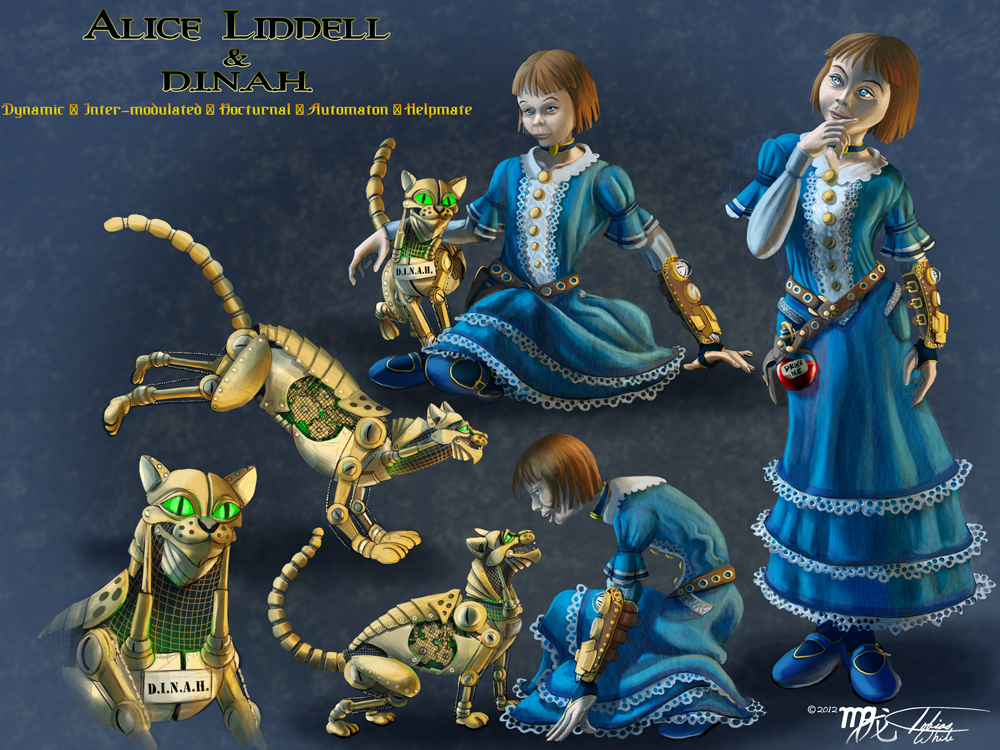
This is a special project I am working on which combines the elements of Wonderland characters, steam punk and the history of the Opium Wars. The concept is fairly loose still but is starting to develop more and more each day that I work on it. I am unsure of what the final direction this project will be used for as it could be anything from a web comic, graphic novel or visual development for either the movie and video game industry.
Check out more of my work at Tobias White Illustrations
You should also follow me on Facebook, linkedin, Deviant Art, or catch me on Tweeter at @TobiasWhite1
Tuesday, May 29, 2012
Steam Punk: Beginnings
Recently, just about a month before I graduated. I was fortunate enough to be able to participate in a month long Steam Punk gallery show called Steam Punk: Beginnings. The show was a big success and all the artists featured in the show did illustrations based off of books by J.K. Jeter, Tim Powers, James Blaylock who not only are Cal State Fullerton Alumni, but started the whole steam punk genre. The two illustrations below are two of my works that got selected for the show and are based off of Tim Power's Anubis Gates. At the show I even got to meet Tim Powers and found he was a really approachable and friendly. He also told me that my depiction of Horrabin the Clown was spot on to what he envisioned when he wrote the book. 
Check out more of my work at Tobias White Illustrations
You should also follow me on Facebook, linkedin, Deviant Art, or catch me on Tweeter at @TobiasWhite1
Back to Blogging
After a long hiatus from blogging . . . I am back. I have just recently graduated from Cal State Fullerton with a BFA in Illustration and with honors to boot. The man next to me in the photo is my illustration instructor Cliff Cramp who gave me the instruction and motivation I needed to become a stronger artist. I am now pursuing my career as an illustrator and as a visual development artist. In order to help me gain more notice on the web I have returned to this old blog and I will be updating as I go. I also have a website which is now up to date and you can find more of my artwork there. http://www.wix.com/itosaithwebb/tobiaswhiteillustrations This is a temporary website and hopefully soon I will have a new website.
Check out more of my work at Tobias White Illustrations
You should also follow me on Facebook, linkedin, Deviant Art, or catch me on Tweeter at @TobiasWhite1
Wednesday, May 19, 2010
Growing the bean stalk and finished building

A little more progress on my project. The Bean stalk took me a little longer than I thought. Oddly I can paint faster than doing a collage.
Check out more of my work at Tobias White Illustrations
You can also follow me on Deviant Art or catch me on Tweeter at
Building the castle up

I am finally getting around to getting this project done. I don't think I was feeling well earlier yesterday because I was knocked out most of the day. Anyways, after getting some practice in on my Yoda piece it gave me a better idea how to handle some obstacles that I will be facing in this one because the layering and 3D separating is going to be very intricate so I am hoping everything goes the way I planned.
Saturday, April 10, 2010
Done Friday night
Tuesday, March 30, 2010
Mickey's Escape
Subscribe to:
Posts (Atom)